
Written by Carmin Nezat
Sassafras albidum is a deciduous tree in the Laurel family and is native to North America. It can be found from southern Ontario west to Iowa and south to central Florida to eastern Texas. It is said to be one of the only native spices to this country. Prevalent in alluvial and upland zones and thrives in well-drained soils. Sassafras forms thickets through vegetative root suckering, sending up new shoots (suckers) from a shallow, wide-spreading lateral root system. These shoots are genetic clones connected to the parent tree and often appear several feet away in sunny openings, old fields, and fence rows. Leaving suckers un-mowed or cutting outer stems can expand a naturalized thicket or privacy screen, whereas regularly pruning off suckers keeps a single-trunk tree or controlled shape. But digging up and moving suckers often fails because young shoots rely heavily on the parent root system and have few independent roots of their own. Container-grown seedlings generally establish more reliably.
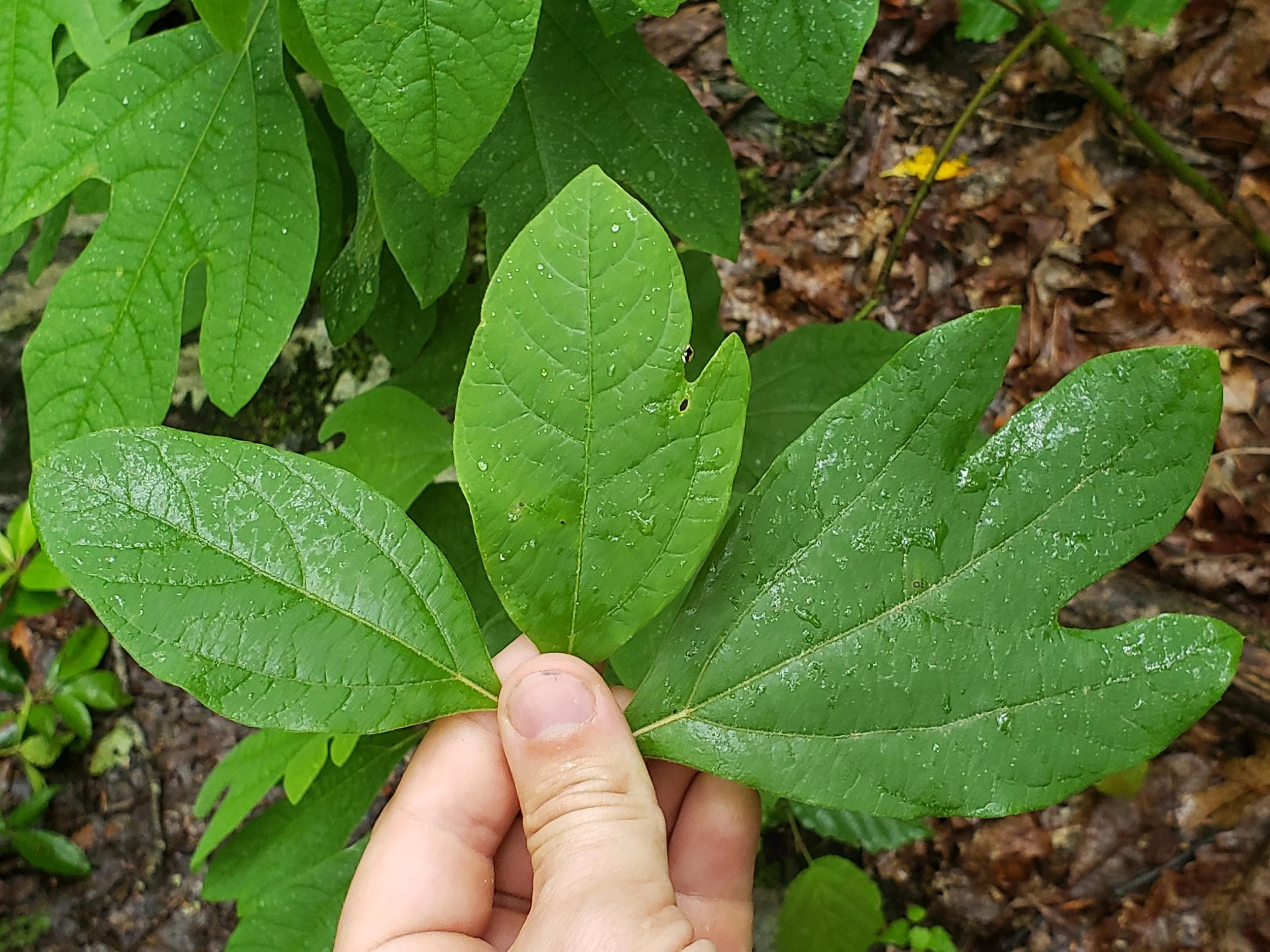
It is a heterophyllous species, with three different leaf shapes: Unlobed: Blade, Two-Lobed: Mitten, Three-lobed: Trident.
We Louisianians know the Sassafras tree, or its leaves, rather, as what makes gumbo file’. And while its known in Cajun and Creole cuisine, the knowledge of the Sassafras tree can be attributed to the Houma and Choctaw nations.
“The claims of a Choctaw etymology point to the term kombo, referring to ground sassafras leaves (filé); in his 1909 monograph ‘The Choctaw of Bayou Lacomb’, anthropologist David Bushnell records the word as kombo ashish, with a(k)shish meaning ‘root or nerve.’ And although it seems strange that Bushnell refers to ground leaves as a root, Scierra LeGarde, a member of the Bayou Lacombe Choctaw community, interprets this in a more metaphorical way: a gumbo is not a gumbo without sassafras, essentially making it ‘gumbo’s root.’ And that’s about it. Earlier dictionaries of the Choctaw language, including by the missionary Cyrus Byington, and by Allen Wright (the nineteenth-century Choctaw chief who suggested the name ‘Oklahoma’ for the future state) leave out the term kombo entirely. Instead, the term kvfi (Oklahoma Choctaw spelling, pronounced ‘cuffee’) is listed as the word for ‘sassafras.’ In fact, elsewhere in Bushnell’s same monograph, he lists the term kafe ashish (his spelling) as the term the Bayou Lacombe Choctaw use to refer to the sassafras root.” (*Choctaw Gumbo - 64 Parishes)
The creation and recipe of gumbo (which of course is a dish that came from the melding of French cuisine, enslaved African people and immigrants from the Caribbean islands along with the Native people’s influence) is a result of all of these cultures melding together. Not only is gumbo -which comes from the African Umbundo “ochingombo” or “kingombo” by the African Tshiluba people -which are both just the word for ‘okra.’ Gumbo, a traditional food cooked hundreds if not thousands of years ago that survived all this time and stayed true to its original ingredients, at least as a base, depending on the region in Louisiana and which old French-speaking mawmaw’s recipe you follow.
“For hundreds of years the Choctaw Indians have had a settlement at Bayou Lacombe on the North Shore of Lake Pontchartrain, and they had a way of making Gumbo long before the white man and the black man arrived. They invented file’. The tender green leaves of the sassafras tree are gathered, dried, and ground to a powder. Only a few tablespoons of the powder will thicken a whole pot of Gumbo and give it a flavor that’s spicy and pleasant. The file’ must always be added after the pot is removed from the fire. If allowed to boil, it becomes stringy and unpalatable. Okra and file’ should never be used together in a Gumbo or it will be as thick as mud. The Creoles in New Orleans used file’ only in the wintertime, when fresh okra was not available, but many Cajuns prefer file’ gumbo year round.”
Our friend Dusty Fuqua’s 2026 presentation “Picking and Pounding: Foraging Sassafras for Gumbo File’,” highlights the tradition and historical importance of the process. “As devout Catholics, Cane River Creoles traditionally harvested sassafras around August 15th – the Feast of the Assumption – but the choice of that date is rooted in ecological knowledge imparted by the Choctaw. This harvest is the Midpoint between the Summer Solstice and the Autumnal Equinox.
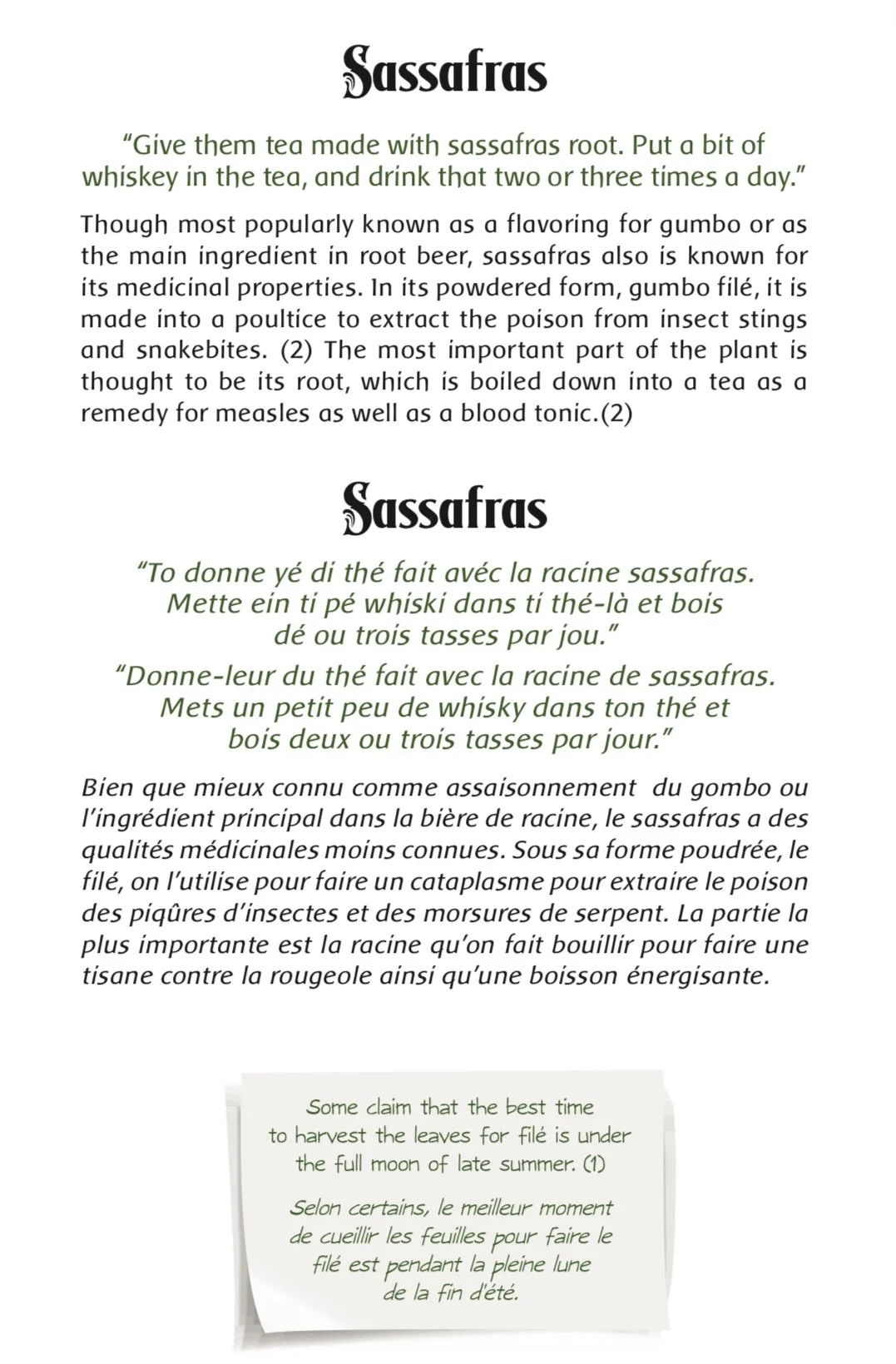
Cajun tradition also dictates that the best time for harvest is under the full moon or late summer. Healers-Garden-Brochure-Web.pdf p. 11
That’s when more sap is said to be in the leaves, boosting the plant’s medicinal properties. Many filé makers now harvest earlier in the summer, perhaps due to climate change. Sassafras leaves are gathered by hand from the living tree and stored in sacks. The gathered leaves are dried slowly and carefully cured indoors. The dried leaves are de-stemmed one-by-one to remove undesirable material. This practice ensures strong aromatic flavors and maximizes the characteristic green color hue of Filé. Traditionally, dried leaves were “pounded” into filé powder using a wooden mortar (a “pile”) and pestle (a “pilon”.)
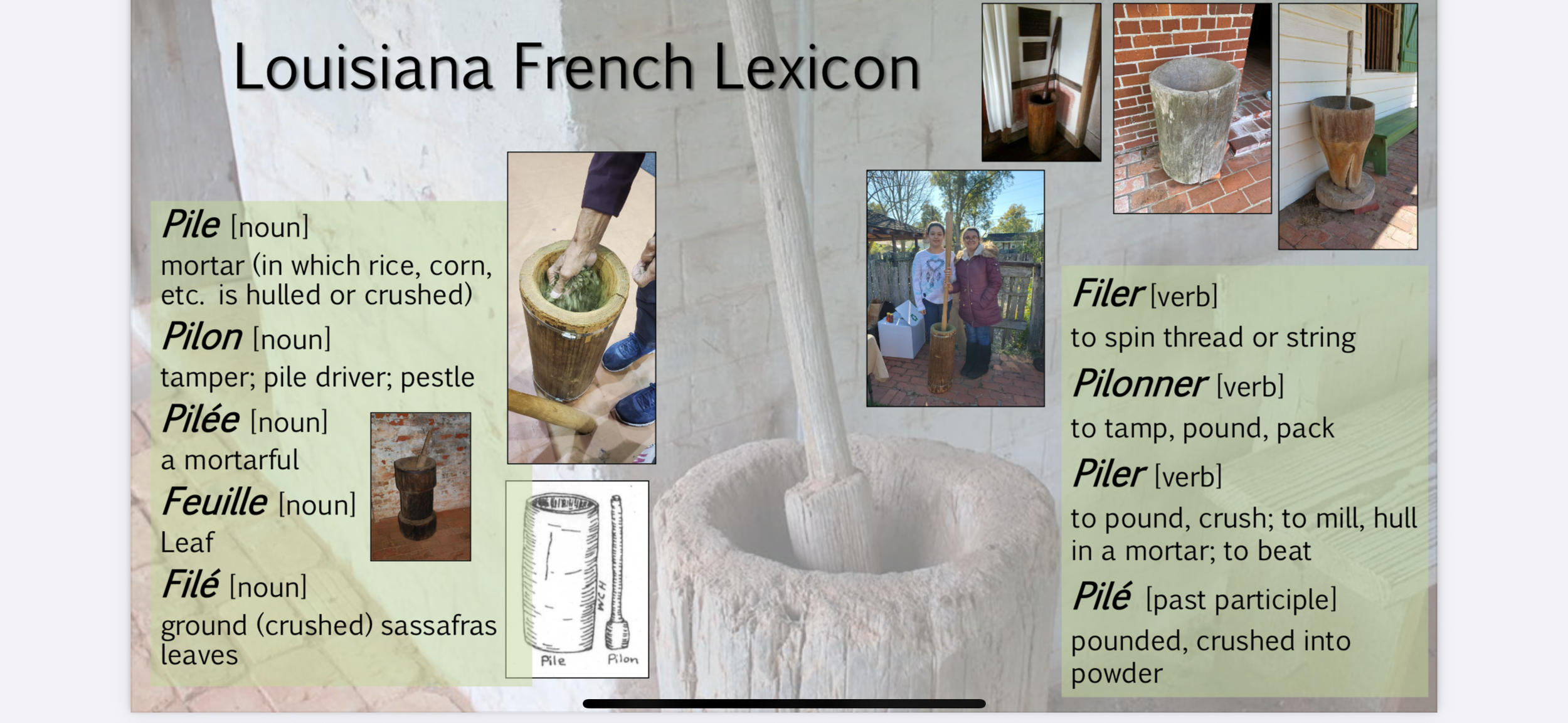
Slide from Dusty Fuqua’s “Picking and Pounding: Foraging Sassafras for Gumbo File’”
Today, culinary artists often use grinding mills or modern blenders to make filé powder. Commercial spice manufacturers utilize machinery for mass production and seldom adhere to traditional standards of quality. Hand-pounded Gumbo Filé making is formally recognized as a Louisiana Master Folk Art and an endangered traditional craft” (*Dusty Fuqua’s “Picking and Pounding: Foraging Sassafras for Gumbo File’”).
Sassafras is widely considered a medicine plant among Native American Tribes, Creoles, and Cajuns in Louisiana, and other traditional communities of the Gulf Coast, Appalachia, Ozarks, and Mid-Atlantic U.S. Medicinal uses include sassafras as an analgesic, anti-diarrheal, anti-emetic, gastrointestinal aid, laxative, pediatric aid, urinary aid and even for ceremonial medicine. It may be best known in Cajun country as a “blood purifying tonic,” and as a fever-reducing tea.
Other traditional Cajun applications listed the dried and powdered leaves for insect and snake bites and the boiled root tea for measles and as a “spring tonic.” These applications were learned via the Houma and Choctaw.
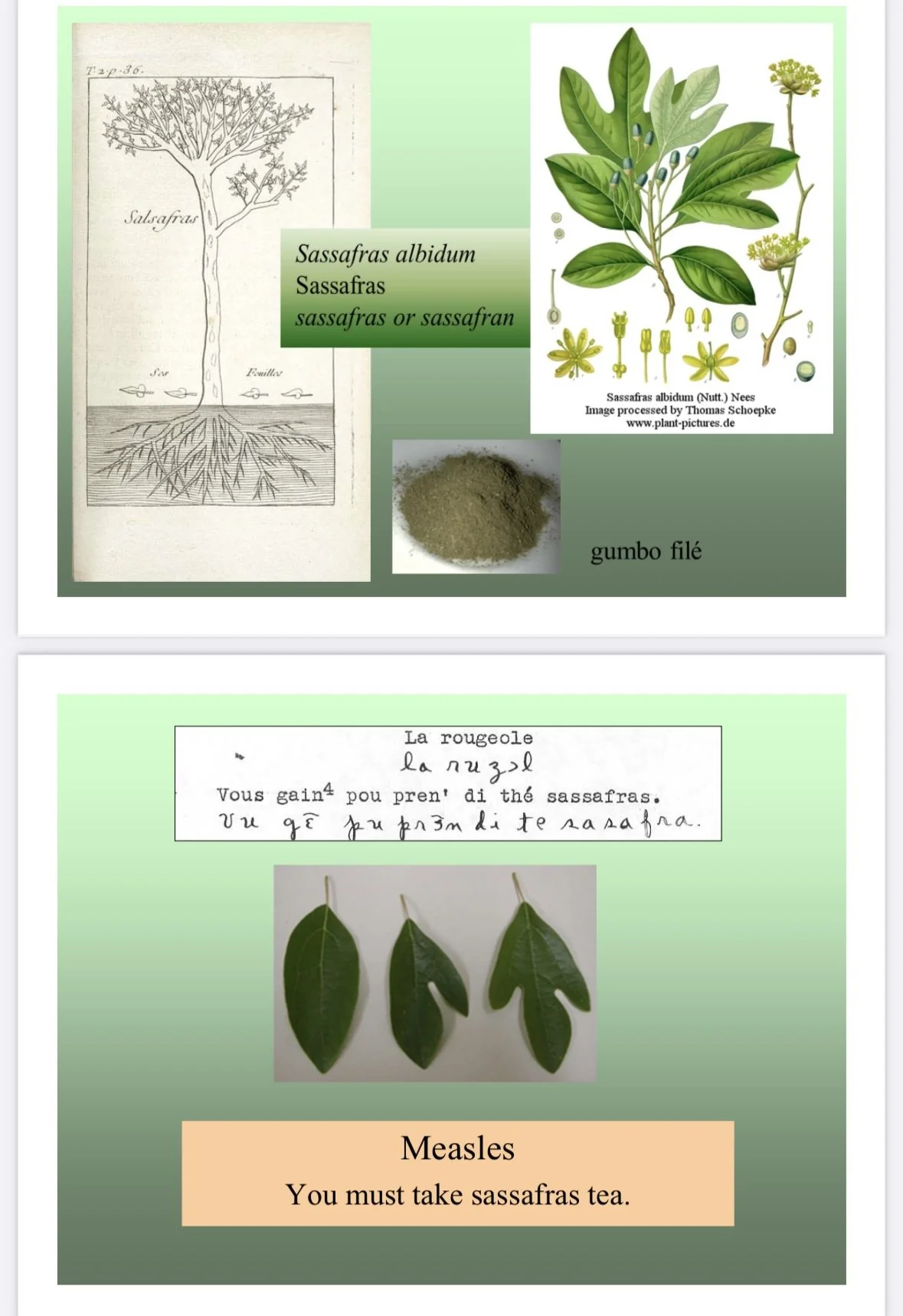
Slide from “Herbal Healing Traditions of South Louisiana” C. Ray Brassieur, Ph.D. Associate Prof. of Anthropology.
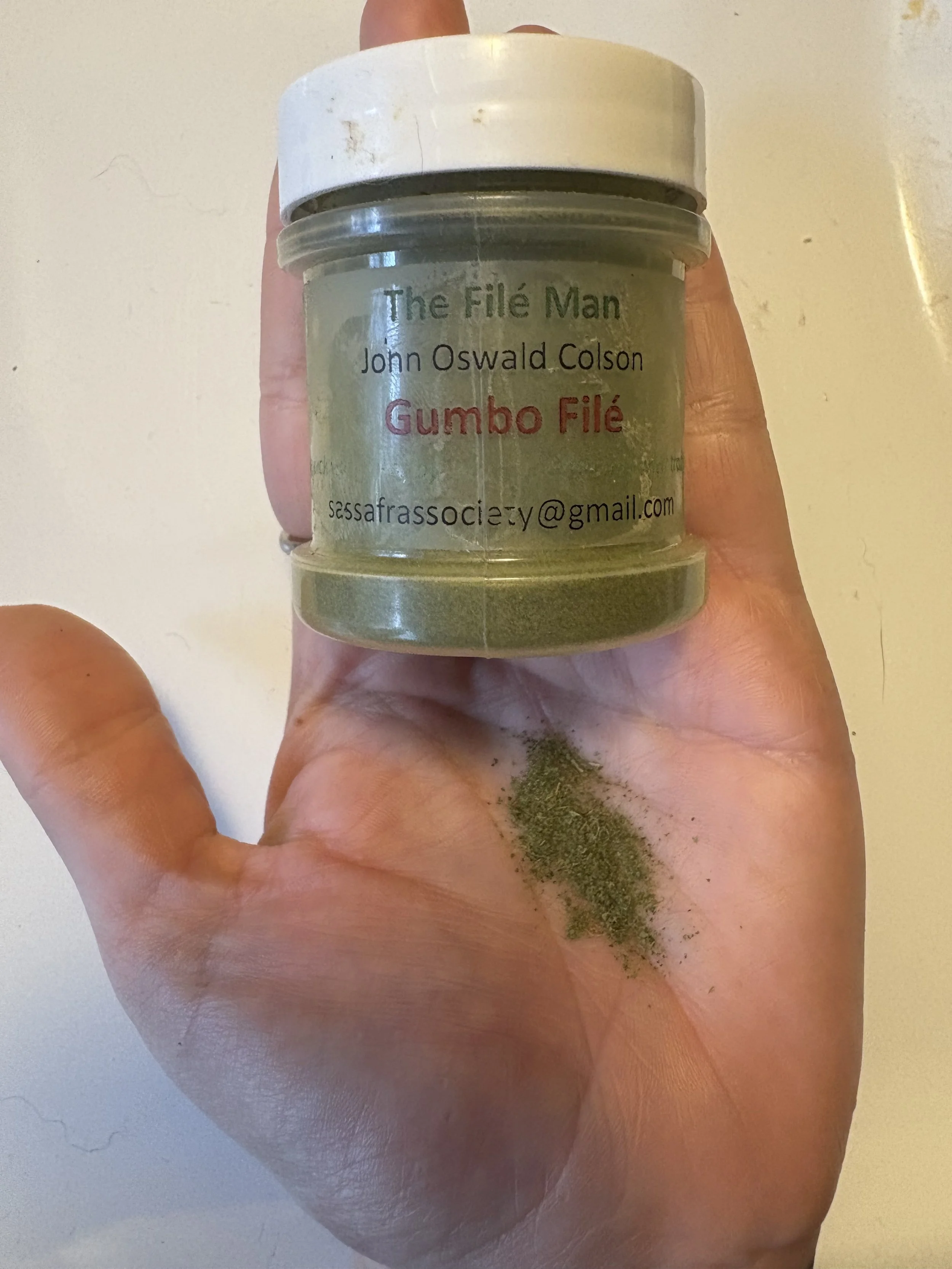
We remember Mr. John Oswald Colson (October 23, 1937 – October 5, 2022) renowned filé maker, tour guide, oral historian, and cultural ambassador for the Cane River Creole community in Natchitoches, Louisiana. Known affectionately as the “Filé Man,” he spent over 60 years preparing traditional filé — a seasoning made from ground sassafras leaves — and sharing the history, traditions, and landscapes of the Cane River.
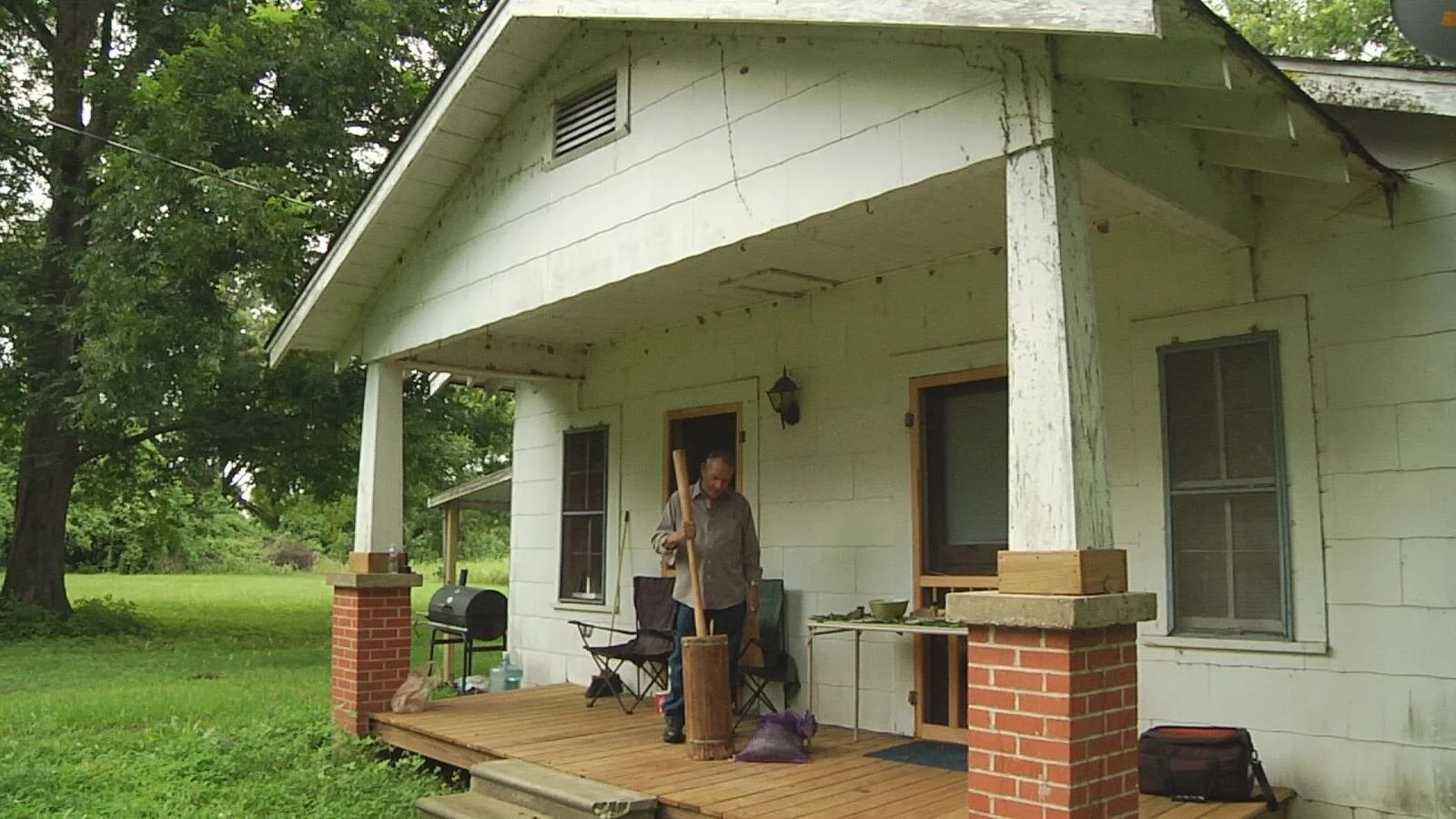
kalb.com “Meet Natchitoches’ very own File’ Man”
This information is for educational and historical purposes. The Indigenous peoples mentioned are still living cultures and when past tense is used, it is to describe practices in a historical context.
Do not attempt to use plants unfamiliar to you as a medicine or food, especially when there are noted hazards. Please always do accurate research, be cautious of any allergies you may have, and/or talk to your doctor about Herb-Drug-Interactions before consuming or using wild plants medicinally. Additionally, when foraging, be aware of any contamination from polluted soil, animal waste, herbicides or pesticides, do not EVER forage from roadsides due to both traffic hazards and certainty of roadway pollution.
https://www.jenachoctaw.org/culture-history/history
https://64parishes.org/suffering-sassafras
https://64parishes.org/choctaw-gumbo
Obit: John Oswald Colson | Natchitoches Parish Journal
Moerman, Daniel. Native American Medicinal Plants. p446, Houma and Choctaw applications Sassafras
Hamel, Paul B. and Mary U. Chiltoskey, 1975, Cherokee Plants and Their Uses -- A 400 Year History, Sylva, N.C.Herald Publishing Co.
http://slaverebellion.info/index.php?page=crops-slave-cuisines
Creole Gumbo and All That Jazz. Howard Mitcham 1978. http://www.nolacuisine.com/2006/07/03/homemade-file-powder/
Bayouvermillionsdistrict.com- Healer’s Garden Brochure, sassafras
Sturtevant, William, 1954, The Mikasuki Seminole: Medical Beliefs and Practices, Yale University
Seduced by Sassafras | The World's Best Gardening Blog
“Herbal Healing Traditions of South Louisiana” C. Ray Brassieur, Ph.D. Associate Prof. of Anthropology. Presentation 2014
“Picking and Pounding: Foraging Sassafras for Gumbo File’” Dusty Fuqua. Presentation 2026